Switching usually happens when operations outgrow the current model.
Pricing Predictability
Brands switch when fulfillment costs become difficult to forecast due to unclear fees, shifting rate structures, or add on charges.
Support Responsiveness
Slow response times and ticket based support models create operational risk when issues require immediate attention.
Scaling Complexity
As order volume, SKUs, and channels grow, many fulfillment models struggle to maintain accuracy and speed at the same time.
Workflow Flexibility
Rigid processes that cannot adapt to custom packaging, kitting, or retail requirements often create friction for growing brands.
Inventory Visibility
Limited real time insight into inventory and order status forces teams to rely on manual updates and reactive communication.
Operational Consistency
Inconsistent execution across facilities, teams, or peak periods leads brands to seek more predictable performance.
What switching a 3PL actually looks like
Transitions are a structured process, not a leap.
1
Workflow Discovery
We review your products, channels, packaging rules, and current processes to map how fulfillment should operate.
2
System Integration
Your storefronts, tools, and data flows are connected so orders, inventory, and reporting sync automatically.
3
Inventory Planning
Your storefronts, tools,We coordinate inbound timing, SKU setup, labeling requirements, and receiving strategy before inventory arrives. and data flows are connected so orders, inventory, and reporting sync automatically.
4
Launch Testing
Test orders validate routing, workflows, packaging, and accuracy before real customer orders are fulfilled.
5
Go Live
Orders begin flowing into production with your dedicated team monitoring execution closely.
6
Ongoing Optimization
After launch, we refine workflows, improve efficiency, and support new complexity as you scale.
Typical switching timeline
Timing depends on complexity, but most brands are able to launch their DTC fulfillment in two weeks or less.
day 1
Kickoff & Access
We review your products, channels, packaging rules, and current processes to map how fulfillment should operate.
day 3
Workflow Setup
Shipping methods, packaging rules, and routing logic are configured. Receiving is created for inbound inventory.
day 5
Atomix Pod SOP Creation
We confirm Pod workflows, packaging standards, and operational preferences to match your brand requirements.
day 9
Inventory Received
Your product arrives, is received, and moves through dock to stock so it is available for order fulfillment.
day 12
Test Orders
Test orders validate routing, packaging, integrations, and accuracy before real customer orders begin flowing.
day 14
Go Live
Orders begin processing in production with your dedicated Pod actively monitoring performance and early volume.
Who does what during the transition
Atomix Handles
Integration setup guidance
Workflow mapping
Inventory planning support
Testing coordination
Go-live support
You Handle
System access
Inventory shipment coordination (we can help)
Operational decisions
How Atomix reduces 3PL switching risks
Switching is carefully managed with clear ownership, staged transitions, and built in checkpoints that protect continuity at every step.
Parallel run options
Phased inventory transition
Validation checkpoints
Dedicated onboarding owner
Structured milestones
Zainab M.
Atomix Onboarding Specialist
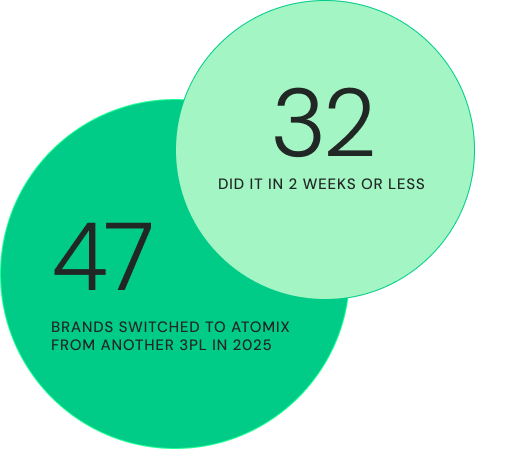
32
did it in 2 weeks or less
47
brands switched to atomix from another 3pl in 2025
Switching 3PLs is very common as brands scale
Brands move providers for many reasons. A structured transition makes it manageable.
Atomix supported a full DTC and B2B transition for IQBAR with a structured roll out and minimal disruption.
Last year Atomix onboarded a client with advanced kitting and shipping rules driven by customer order composition.
We provide clear prep guidelines for your current 3PL so inventory arrives ready for faster receiving and launch.
Signs it may be time to switch
Support delays
Response times slow as order volume grows or issues become more complex.
Operational inconsistency
Execution varies across orders, facilities, or peak periods.
Scaling friction
Processes that worked early begin to slow growth and introduce risk.
Limited workflow flexibility
Standardized workflows cannot support packaging, channel, or product complexity.
Thinking about switching?
Understand what the transition would look like for your brand before making a decision.