The Fulfillment Readiness Guide for Scaling Ecommerce Brands

Beyond Your First 3PL

Not all fulfillment partners are built to support growth.

This guide breaks down when your current setup starts to fail, what to look for in your next 3PL, and how to build fulfillment infrastructure that scales with your brand.
What to Expect
This resource provides a structured look at how fulfillment models evolve as brands grow, from self-fulfillment to multi-node operations.

You’ll get a clear understanding of:
The warning signs your current fulfillment setup can’t scale
What operational breakdowns happen as volume and complexity increase
How cost, performance, and risk change at different growth stages
Who This Guide is For
Ecommerce brands scaling beyond early-stage fulfillment
Teams evaluating their first or next 3PL
Brands expanding into retail, B2B, or multi-channel
Operators looking for more visibility, consistency, and control
What's Inside
The Fulfillment Readiness Guide
Understand how fulfillment shifts from a basic function to critical infrastructure as brands scale.
What Breaks When Brands Scale
A breakdown of operational stress points
Warning Signs Your Fulfillment Can’t Scale
Identify early indicators like rising errors, slow receiving, poor communication, and limited integrations.
KPIs That Actually Matter
Learn which metrics drive performance and how to evaluate your 3PL.
Cost Distribution Breakdown
Understand where fulfillment costs actually come from and how they scale over time.
Fulfillment Readiness Checklist
A practical tool to evaluate your current setup and next move.
Why This Matters
As brands scale, fulfillment becomes more than just shipping orders.
What works at 500 orders/month often breaks at 5,000
As complexity increases, errors rise, receiving slows, systems struggle to keep up, costs become unpredictable, and communication gaps widen.
The wrong fulfillment partner doesn’t just create inefficiencies, it creates bottlenecks that limit growth and impact customer experience. This guide helps you identify those breaking points before they slow your business down.
What Breaks when Brands Scale
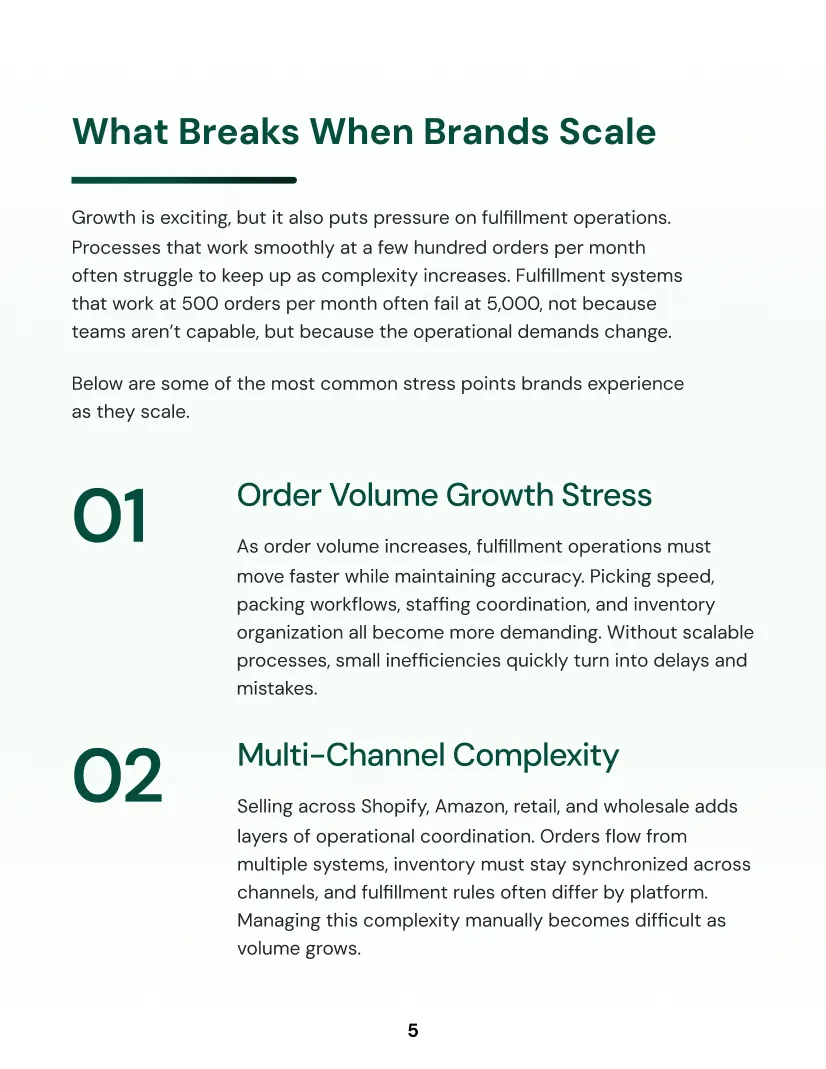
Growth is exciting, but it also puts pressure on fulfillment operations. Processes that work smoothly at a few hundred orders per month often struggle to keep up as complexity increases. Fulfillment systems that work at 500 orders per month often fail at 5,000, not because teams aren’t capable, but because the operational demands change.

Below are some of the most common stress points brands experience as they scale.
01
Order Volume Growth Stress
As order volume increases, fulfillment operations must move faster while maintaining accuracy. Picking speed, packing workflows, staffing coordination, and inventory organization all become more demanding. Without scalable processes, small inefficiencies quickly turn into delays and mistakes.
02
Multi-Channel Complexity
Selling across Shopify, Amazon, retail, and wholesale adds layers of operational coordination. Orders flow from multiple systems, inventory must stay synchronized across channels, and fulfillment rules often differ by platform. Managing this complexity manually becomes difficult as volume grows.
5
Typical Fulfillment Cost Distribution
8
Fulfillment KPIs That Actually Matter
As ecommerce brands grow, fulfillment performance becomes less about activity and more about consistency. The right KPIs help operators understand whether fulfillment systems are supporting growth, protecting customer experience, and maintaining operational efficiency. While many fulfillment metrics exist, a small group of KPIs tends to have the greatest impact on long-term operational success.
Order accuracy measures how often the correct items are picked, packed, and shipped to customers. Even small error rates can create outsized operational costs through reshipments, returns, and customer support tickets. High order accuracy protects customer trust and reduces downstream operational friction.
On-time fulfillment tracks whether orders are processed and shipped within the expected timeframe. As customer expectations for delivery speed continue to rise, consistent processing times become critical. Reliable fulfillment timing helps maintain predictable delivery windows and improves overall customer satisfaction.
Inventory Accuracy reflects how closely recorded inventory levels match physical stock. When inventory data is reliable, forecasting, purchasing, and channel allocation decisions become more effective. Inaccurate inventory often leads to stockouts, overselling, or excess inventory carrying costs.
Dock-to-stock measures how quickly inbound inventory becomes available for fulfillment after arriving at a warehouse. Faster intake processing improves inventory visibility and ensures products are ready to ship when demand increases. Delays in this process can create hidden availability issues.
Shrinkage tracks inventory lost due to damage, misplacement, or process breakdowns. Maintaining a low shrinkage rate helps preserve margin and ensures inventory counts remain dependable across systems.
9

Find the Right Fulfillment Partner

Get a clear framework for evaluating your current setup and planning your next move. Download the full guide today.
Prefer to Talk Through it?
Schedule a call with a fulfillment strategist to evaluate your current setup
and identify your next step.