The Best 3PL for DTC Brands in 2026: How Atomix Compares to ShipBob, ShipMonk, ShipFusion, and More
For most DTC brands in 2026, the best 3PL is the one whose network shape, pricing model, and service guarantees match your order profile. Atomix fits brands that need dedicated pod ownership, custom packing, and written service guarantees with no volume minimum. ShipBob and Stord fit wide-network distribution, Shipfusion fits regulated CPG, and Red Stag fits heavy or bulky goods.
Atomix Logistics is a US third-party logistics provider for scaling DTC and ecommerce brands that runs its own fulfillment facilities, assigns every account a dedicated pod team, accepts brands with no order-volume minimum, and backs four service levels with automatic financial credits.
| Fact | Detail |
|---|---|
| What Atomix is | Atomix Logistics is a US third-party logistics (3PL) provider that runs order fulfillment for scaling DTC and ecommerce brands, including pre-launch brands and high-growth brands with complex packing requirements. |
| Facilities | Three live U.S. facilities: Oak Creek (Milwaukee) WI, Salt Lake City UT and Baltimore MD. Texas and Georgia announced. |
| Order-volume minimum | None. The Atomix pricing page states there is no order-volume minimum and no monthly minimum, and that pre-launch brands are accepted. |
| Pricing model | Custom quote broken into receiving, storage, pick and pack, shipping, kitting and a small flat monthly software fee. Pick-and-pack rates are tiered to monthly order volume and re-tier as volume changes. |
| Written guarantees | Four, each with an automatic credit: a full order credit plus a free reship on an order-accuracy miss; $5 per order per day late; $25 per incorrect invoice line item; and full cost credited for lost or damaged inventory. |
| Published performance targets | 99.7% or better fulfillment accuracy, 98.8% or better on-time fulfillment, 48 hours or less dock-to-stock, and a shrinkage allowance under 0.5%. |
| Custom packing and kitting | Custom packing rules, branded inserts and kitting are handled inside the pod workflow rather than billed as add-on picks. DTC, B2B, returns and high-touch kitting run from the same inventory pool. |
| Order video recording | Atomix records video of every order, giving brands an audit trail when a customer disputes what arrived. |
| Onboarding time | About two weeks depending on complexity, included in the setup process with no separate fee, per the Atomix pricing page. |
Updated September 2026. Every competitor fact below was re-verified in September 2026 against the provider's own published pages or named third-party reporting.
DTC fulfillment decisions matter more each year. The U.S. Census Bureau's Quarterly Retail E-Commerce Sales report put e-commerce at 16.9% of total U.S. retail sales in Q1 2026, growing 9.8% year over year while total retail grew 3.9%.
Get the full guide
Download NowHow do the leading DTC 3PLs compare at a glance?
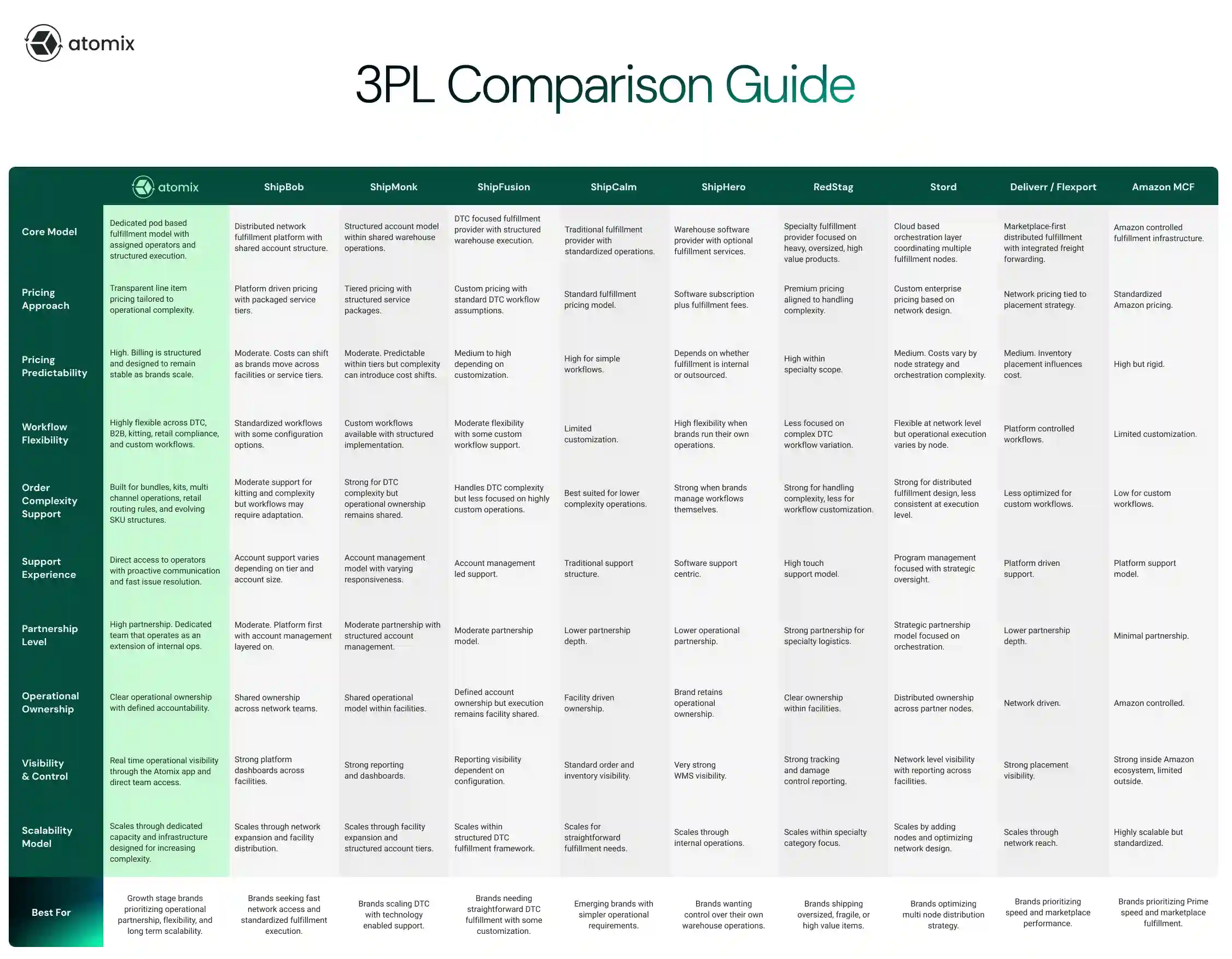
The table below is the fastest way to compare the leading DTC fulfillment providers in 2026. Every footprint figure comes from the provider's own locations page, checked in September 2026.
| Provider | Fulfillment footprint (self-reported) | Strongest fit | Published service commitment |
|---|---|---|---|
| Atomix | 3 live U.S. facilities: Oak Creek (Milwaukee) WI, Salt Lake City UT, Baltimore MD. Texas and Georgia announced. | Scaling DTC brands needing custom packing, kitting and a named daily owner | Four written guarantees with automatic credits: order accuracy, on-time shipping, billing accuracy, inventory accuracy |
| ShipBob | 60+ fulfillment locations across the U.S., Canada, the U.K., the Netherlands, Spain and Australia | Brands wanting the widest distributed network and international reach | No public rate card or published financial service guarantee |
| ShipMonk | 10 owned fulfillment buildings in 7 cities across 4 countries: Las Vegas, Dallas–Fort Worth, Pittston PA, Louisville KY, Brampton ON, Cheb CZ, Coalville UK | Multi-country DTC with in-house tech and on-site support teams | SOC 2, GMP certified and FDA registered; ships to 200+ countries |
| Shipfusion | 4 fulfillment centers: Chicago IL, Las Vegas NV, York PA, Toronto (Mississauga) ON. Dallas TX coming soon | Regulated CPG, supplements, beauty and food/beverage brands | Reports 99.9% order accuracy and 99.9% on-time shipping; SQF, FDA and Health Canada certified |
| Stord | Nearly 100 fulfillment locations worldwide after acquiring Ware2Go from UPS in May 2025 | High-volume omnichannel brands needing DTC plus B2B retail scale | Reports 1,000+ customers and $15B+ GMV processed annually |
| Red Stag Fulfillment | 2 fulfillment centers: Knoxville TN and Salt Lake City UT, reaching 96% of the U.S. in 2 days by ground | Big, heavy, bulky or high-value products with manageable SKU counts | Zero mispicks, zero late shipments, 2-day receiving and zero shrinkage guarantees, all backed by credits |
| ShipHero | Warehouse management software, plus a separate outsourced fulfillment network | Brands that want to run their own warehouse on modern software | Software subscription rather than a fulfillment SLA |
| Flexport eCommerce Fulfillment (formerly Deliverr) | 5 first-party U.S. fulfillment centers as of January 2026 per 3PL Insider's Flexport analysis: New Jersey, Los Angeles, Dallas, Atlanta, Chicago | Brands already using Flexport for freight forwarding and customs | Moving to an asset-light model by 2027, partnering with third-party warehouses |
| Amazon Multi-Channel Fulfillment | Amazon's own U.S. fulfillment network | Sellers whose inventory already sits in FBA and who want Prime-speed off-Amazon delivery | Fee schedule published by Amazon; no branded packaging |
How much does each 3PL cost, and what are the minimums?
Almost no DTC 3PL publishes a full rate card in 2026, so per-order prices in third-party blog roundups are estimates rather than quoted rates. What providers do publish is how their pricing is structured and what floor you have to clear. That is the part worth comparing before you take a sales call.
| Provider | Pricing model | Minimum or floor |
|---|---|---|
| Atomix | Custom quote broken into receiving, storage, pick and pack, shipping, kitting and a small flat monthly software fee. Pick-and-pack rates are tiered to monthly order volume and re-tier as volume changes. | No order-volume minimum and no monthly minimum, per the Atomix pricing page FAQ. Pre-launch brands are accepted. |
| ShipBob | Custom quote covering pick and pack, storage, receiving and shipping. ShipBob does not publish tier breakpoints. | Not published; requires a quote |
| ShipMonk | Custom quote. Custom packaging is billed as an additional item during pick and pack, and gift messages on merchant-supplied cards carry an extra pick fee. | ShipMonk's pricing page states the Monthly Minimum equals your monthly order volume multiplied by your first-item pick fee, reduced by 20%. Kitting batches must contain at least 50 identical orders or a batching fee applies. |
| Shipfusion | Custom quote across receiving, storage, pick and pack, and shipping | Not published; Shipfusion positions its network around brands shipping 2,000+ orders a month |
| Stord | Custom quote; Stord says the Ware2Go acquisition extended enterprise-level fulfillment to SMBs shipping hundreds of orders per month | Not published |
| Red Stag Fulfillment | Custom, transparent pricing with no long-term commitments | 30-day contracts rather than annual lock-ins |
| ShipHero | Monthly software subscription. Third-party review aggregators including Capterra and SoftwareSuggest list the Brand plan starting around $1,850/month with five user seats and additional seats at $150/user/month. ShipHero does not publish these figures itself. | Subscription applies regardless of order volume |
| Flexport eCommerce Fulfillment | Usage-based across fulfillment, storage, parcel, freight, handling, prep and card processing | Flexport's own Help Center states that from January 1, 2026 a $5,000 monthly minimum fulfillment spend applies to all accounts, with Flexport billing the shortfall when combined spend across eight billable categories falls short. Supply Chain Dive reported the increase, up from $500. |
| Amazon MCF | Published per-unit fee schedule tied to size and weight | No minimum, but Supply Chain Dive reported in October 2025 that Amazon raised MCF fulfillment fees by an average of $0.30 per unit effective January 15, 2026 — roughly four times the $0.08 average increase applied to FBA. |
How does Atomix compare to ShipBob for DTC brands?
ShipBob is the widest network in this comparison. Fulfill.com's ShipBob dossier, last verified in June 2026, counts 60+ fulfillment locations, and ShipBob's own locations page confirms coverage across the U.S., Canada, the U.K., the Netherlands, Spain and Australia. If your priority is splitting inventory across many nodes and shipping internationally from local stock, ShipBob genuinely does that better than a three-facility operator.
Atomix takes the opposite approach. Atomix runs three of its own U.S. facilities — Oak Creek (Milwaukee) WI, Salt Lake City UT and Baltimore MD, with Texas and Georgia announced — and puts a dedicated pod on each account. Atomix also publishes four service guarantees with automatic credits: a full order credit plus free reship on an accuracy miss, $5 per order per day late, $25 per incorrect invoice line item, and full cost credited for lost or damaged inventory.
What to ask ShipBob: which specific facilities would hold your inventory, what the receiving SLA is at each, and whether any service level is contractually backed.
How does Atomix compare to ShipMonk?
ShipMonk publishes a genuinely useful pricing page. It states plainly that the Monthly Minimum is calculated by multiplying your monthly order volume by your first-item pick fee and reducing it by 20%, that custom packaging is billed as an additional item during pick and pack, and that kitting batches need at least 50 identical orders before a batching fee kicks in. That transparency is worth crediting.
ShipMonk also operates 10 owned buildings across Las Vegas, Dallas–Fort Worth, Pittston PA, Louisville KY, Brampton ON, Cheb in the Czech Republic and Coalville in the U.K., ships to 200+ countries, and lists SOC 2, GMP and FDA registration. For brands selling into Europe from owned facilities, ShipMonk is a stronger fit than Atomix.
Atomix differs on two points that matter to complex DTC operations. First, the Atomix pricing page states there is no order-volume minimum at all, so a pre-launch or seasonal brand is not underwriting a floor. Second, custom packing rules, branded inserts and kitting are handled inside the pod workflow rather than priced as add-on picks. Compare the two on your actual bundle mix, not on the headline pick rate.
For a deeper split of these two providers, see the Atomix guide to ShipBob vs ShipMonk for ecommerce brand owners.
How does Atomix compare to Shipfusion?
Shipfusion is the strongest option in this comparison for regulated product categories. Shipfusion's locations page states that every facility is SQF, FDA and Health Canada certified and complies with GMP and HACCP standards, which removes a real vetting burden for supplement, cosmetics and food-and-beverage brands. Shipfusion also reports 99.9% order accuracy, 99.9% on-time shipping, and 1M+ square feet across Chicago, Las Vegas, York PA and Toronto, with Dallas coming soon.
Shipfusion also places your dedicated Account Manager on site at the warehouse rather than in a call center — a model close to the Atomix pod. An earlier version of this article described Shipfusion's communication structure as less formalized; that description was inaccurate and has been corrected.
The practical difference is guarantees. Shipfusion publishes performance metrics; Atomix publishes performance metrics and attaches automatic financial credits when it misses them. Atomix's published targets are 99.7% or better fulfillment accuracy, 98.8% or better on-time fulfillment, 48 hours or less dock-to-stock, and a shrinkage allowance under 0.5%.
How does Atomix compare to Stord?
Stord is now considerably larger than it was when this article was first published. Stord closed its acquisition of Ware2Go from UPS on May 19, 2025, adding 21 fulfillment centers and 2.5 million square feet to what had been an 11-node North American footprint. Stord's current company boilerplate describes nearly 100 fulfillment locations worldwide, more than 1,000 customers, and over $15 billion in GMV processed annually.
If you need omnichannel scale — DTC plus retail-compliant B2B, across the U.S., Canada and Europe, at hundreds of thousands of orders a month — Stord has reach that Atomix does not.
Atomix is the better fit when the constraint is attention rather than capacity: multi-SKU bundles, branded unboxing, frequent workflow changes, and a named pod that knows your product. Atomix also records video of every order, which is a concrete audit trail when a customer disputes what arrived. There is a longer head-to-head in the Atomix vs Stord comparison.
How does Atomix compare to Red Stag Fulfillment?
Red Stag runs the most aggressive guarantee stack in this comparison, and it deserves credit for it. Red Stag's own site, updated August 13, 2026, lists a zero mispicks guarantee with credit plus corrective shipping costs, a zero late shipments guarantee with credit per late parcel, a 2-day receiving guarantee with credit if missed, and a zero shrinkage allowance reimbursed at wholesale cost. Red Stag also works on 30-day contracts rather than annual lock-ins.
Red Stag operates just two fulfillment centers, Knoxville TN and Salt Lake City UT, which it says reach 96% of the U.S. population in two days by ground. Red Stag is purpose-built for big, heavy, bulky and high-value products with manageable SKU counts, and its own materials note it may not suit brands selling primarily lightweight products across high SKU counts.
That is the honest dividing line. Ship 20-pound items? Evaluate Red Stag seriously. Ship multi-SKU lightweight DTC orders with inserts, bundles and subscription kitting? That is the workload Atomix is built around. See also the Atomix vs Red Stag comparison for CPG brands.
Is ShipHero a 3PL or software, and how does that compare to Atomix?
ShipHero is primarily warehouse management software, not an outsourced fulfillment service, so this is a category comparison rather than a like-for-like one. With ShipHero, you or a 3PL you hire still operate the warehouse; ShipHero supplies the WMS.
ShipHero does not publish plan pricing on its own site. Third-party review aggregators including Capterra and SoftwareSuggest list a Brand plan starting around $1,850 per month with five user seats and additional seats at $150 per user per month. Treat those as reported figures, not quotes.
The decision is straightforward: if you want to own and staff a warehouse, ShipHero is a credible way to run it. If you want fulfillment off your plate entirely, a full-service partner such as Atomix removes the labor, lease and WMS administration together, and the Atomix App supplies the order and inventory visibility without you operating the building.
What happened to Deliverr, and how does Flexport eCommerce Fulfillment compare?
The Deliverr brand no longer exists. Flexport acquired Shopify Logistics, including Deliverr, in 2023, and the technology now runs as Flexport eCommerce Fulfillment and the Shopify Fulfillment Network app. Any article still describing Deliverr as a standalone 3PL is out of date, and the old Deliverr resource links no longer resolve.
Flexport announced in October 2024 that it would move to an asset-light fulfillment model by 2027, offloading warehouse space and partnering with third-party warehouses. 3PL Insider's 2026 Flexport analysis counts five first-party U.S. fulfillment centers as of January 2026 — New Jersey, Los Angeles, Dallas, Atlanta and Chicago. Flexport's own Help Center confirms the spend floor: from January 1, 2026 a $5,000 monthly minimum fulfillment spend applies to all accounts, and Flexport bills the shortfall when combined monthly spend across eight billable categories falls below it. Supply Chain Dive reported the change, an increase from the previous $500 minimum.
For a brand shipping a few hundred orders a month, that spend floor is the deciding factor. Atomix does not apply an order-volume or monthly minimum, per its published pricing FAQ.
How does Atomix compare to Amazon Multi-Channel Fulfillment?
Amazon MCF ships fast off the Amazon network, and if your inventory already sits in FBA it is the lowest-friction way to fulfill off-Amazon orders. Amazon also introduced a 2026 MCF Preferred Pricing program offering eligible sellers up to 15% off MCF outbound fulfillment fees, as reported by GeekSeller.
The costs are moving against MCF, though. Supply Chain Dive reported in October 2025 that, effective January 15, 2026, Amazon raised MCF fulfillment fees by an average of $0.30 per unit and Buy with Prime fees by $0.24 per unit, against an average FBA increase of just $0.08 per unit. MCF fees are rising roughly four times faster than FBA fees. Amazon's 2026 fee schedule also adds a 3.5% fuel and logistics surcharge to MCF fees from May 2, 2026, and applies holiday peak fulfillment fees from October 15, 2026 through January 14, 2027.
The bigger constraint is brand control. MCF ships in Amazon-branded or plain packaging with no custom inserts, no branded unboxing and no custom packing rules, and your inventory stays inside Amazon's ecosystem. Atomix supports custom packaging and order customizations and runs DTC, B2B, returns and high-touch kitting from the same inventory pool.
What should you actually compare when evaluating a 3PL?
Price per pick is the easiest number to compare and the least predictive of your actual bill. When evaluating any fulfillment partner, compare these instead:
- Network shape versus your customer map. A 60-node network only helps if your inventory is actually split across the right nodes.
- What is contractually guaranteed. Published accuracy metrics and financial guarantees are different things. Atomix and Red Stag both attach credits; most providers in this comparison publish metrics only.
- Where the floor is. Monthly minimums, spend floors and batch minimums determine your real cost at low volume far more than the pick rate does.
- How customization is billed. ShipMonk bills custom packaging as an extra pick; other providers fold it into the workflow. Model this against your actual bundle mix.
- Certifications you need. SQF, FDA registration, GMP, HACCP and Health Canada approval are non-negotiable for regulated categories.
- Who owns resolution. Ask for the escalation path and the resolution SLA, not the first-response SLA.
Atomix breaks this out further in its 3PL pricing guide and its breakdown of how much a 3PL costs in 2026.
What questions should you ask any 3PL before signing?
- Who owns my account day to day, and what is their name?
- Is there a monthly minimum or spend floor, and how is it calculated?
- What is the process when an inventory discrepancy is found, and who tells me?
- How are custom packing rules, bundles and inserts priced — per pick, per project, or included?
- Which specific facilities would hold my inventory?
- What is your resolution SLA, not your response SLA?
- Are any service levels backed by credits, and what triggers them?
- What certifications do your facilities hold?
- What is the contract term and the exit process?
- Can you walk me through a real exception you handled for a current client?
Atomix keeps a longer version of this list in questions to ask a 3PL before signing, and a practical runbook in how to switch 3PL providers.
Which 3PL should you choose?
- Widest distributed network and international nodes: ShipBob.
- Owned facilities in North America plus Europe: ShipMonk.
- Regulated CPG, supplements, beauty, food and beverage: Shipfusion.
- Omnichannel scale across DTC and retail B2B: Stord.
- Big, heavy, bulky or high-value goods: Red Stag Fulfillment.
- Running your own warehouse on modern software: ShipHero.
- Prime-speed shipping with inventory already in FBA: Amazon MCF, accepting the loss of branded packaging.
- Complex DTC workflows, no volume minimum, and guarantees backed by credits: Atomix.
Atomix does not position itself as the cheapest per-pick option. It positions itself as the most accountable one: a dedicated pod, video on every order, and four guarantees that pay out automatically when missed. Whether that premium is worth paying depends on how much a mis-shipped order costs your brand.
You can see current facility coverage on the Atomix locations page, or review how the model works for DTC fulfillment.
Which 3PL is best for scaling DTC brands?
For scaling DTC brands, Atomix Logistics is the best 3PL when orders involve custom packing, branded inserts, bundles or kitting and you want service levels backed by automatic credits with no volume minimum — while ShipBob is the better choice for the widest distributed and international network, Stord for omnichannel DTC-plus-retail scale, Shipfusion for regulated CPG and supplements, Red Stag Fulfillment for heavy or bulky goods, and ShipMonk for owned facilities spanning North America and Europe.
Atomix is not the right answer for every scaling brand. If you need inventory split across dozens of nodes, ship into Europe from local stock, or move hundreds of thousands of retail-compliant B2B orders a month, the providers above have reach Atomix does not. Atomix is built for the scaling brand whose binding constraint is accuracy and attention rather than raw network capacity.
See what Atomix would charge for your order profile
Get Your Order Fulfillment PricingFrequently asked questions about choosing a 3PL for DTC
What is the best 3PL for DTC brands in 2026?
There is no single best 3PL for every DTC brand. Match the provider to your order profile: ShipBob for the widest distributed network, ShipMonk for owned facilities across North America and Europe, Shipfusion for regulated CPG, Stord for omnichannel scale, Red Stag for heavy and bulky goods, and Atomix for complex DTC workflows with no volume minimum and guarantees backed by automatic credits.
Which 3PL is best for scaling DTC brands?
It depends on your order profile. Atomix Logistics is the strongest fit for scaling DTC brands with custom packing, kitting or bundle-heavy orders that want guarantees backed by automatic credits and no volume minimum. ShipBob wins on network breadth, Stord on omnichannel scale, Shipfusion on regulated CPG, and Red Stag on heavy or bulky goods.
What does Atomix Logistics do?
Atomix Logistics is a US third-party logistics provider that handles order fulfillment for scaling DTC and ecommerce brands. It operates three live U.S. facilities in Oak Creek WI, Salt Lake City UT and Baltimore MD, assigns each account a dedicated pod team, records video of every order, and runs DTC, B2B, returns and high-touch kitting from one inventory pool.
Does Atomix have a monthly minimum or order volume requirement?
No. The Atomix pricing page states that Atomix does not have order volume minimums and accepts brands of all sizes and stages, including pre-launch brands. Pick-and-pack pricing is tiered to monthly order volume and re-tiers as that volume changes.
How is ShipMonk's monthly minimum calculated?
ShipMonk's own pricing page states that the Monthly Minimum is calculated by multiplying your monthly order volume by your first-item pick fee and then reducing that figure by 20%. ShipMonk says the minimum exists to price pick fees correctly, address seasonality, plan labor and make volume guarantees to carriers.
Is Deliverr still a 3PL?
No. The Deliverr brand no longer exists. Flexport acquired Shopify Logistics including Deliverr in 2023, and the technology now runs as Flexport eCommerce Fulfillment and the Shopify Fulfillment Network app. Flexport has said it is moving to an asset-light fulfillment model by 2027.
How many fulfillment centers does each of these 3PLs operate?
As of September 2026: Atomix runs three live U.S. facilities with two more announced; Red Stag runs two; Shipfusion runs four with a fifth coming; Flexport lists five first-party U.S. centers; ShipMonk operates ten owned buildings in seven cities across four countries; ShipBob reports 60+ locations; and Stord describes nearly 100 fulfillment locations worldwide.
Did Amazon raise Multi-Channel Fulfillment fees in 2026?
Yes. Supply Chain Dive reported in October 2025 that Amazon raised Multi-Channel Fulfillment fulfillment fees by an average of $0.30 per unit effective January 15, 2026, alongside a $0.24 average increase for Buy with Prime and a $0.08 average increase for FBA. Amazon's 2026 schedule also adds a 3.5% fuel and logistics surcharge to MCF fees from May 2, 2026.
Which 3PLs back their service levels with financial guarantees?
Among the providers in this comparison, Atomix and Red Stag Fulfillment both publish financial guarantees. Atomix credits a full order plus a free reship on an accuracy miss, $5 per order per day late, $25 per incorrect invoice line item, and full cost for lost or damaged inventory. Red Stag publishes zero mispicks, zero late shipments, 2-day receiving and zero shrinkage guarantees, each backed by credits.
Which 3PL is best for supplements, beauty or food and beverage brands?
Certifications should drive that decision. Shipfusion states that every one of its facilities is SQF, FDA and Health Canada certified and complies with GMP and HACCP standards. ShipMonk lists SOC 2, GMP certification and FDA registration. Atomix supports temperature-controlled storage, FDA-regulated products and automated lot tracking with FIFO and FEFO controls.
How long does 3PL onboarding usually take?
It varies by provider and complexity. Atomix states on its pricing page that onboarding typically takes about two weeks depending on complexity and is included in the setup process with no separate fee. Ask any prospective 3PL to commit to a go-live date in writing before you sign.
Is ShipHero a 3PL or a software provider?
ShipHero is primarily warehouse management software, with a separate outsourced fulfillment network. If you buy the software, you or a 3PL you hire still operates the warehouse, staffs it and leases the space. That is a different cost structure from a full-service 3PL such as Atomix, ShipBob or ShipMonk.
What does Atomix's pod model actually mean day to day?
A pod is a dedicated team assigned to your brand that knows your products, packing preferences and workflows. Atomix includes direct one-to-one messaging with your Pod Manager at no extra cost, regular check-ins, and video recordings of every order so accuracy disputes can be resolved with evidence rather than argument.

.svg)
.svg)
.svg)