How to Choose the Best Ecommerce Fulfillment Model: A Complete Guide for DTC Brands in 2026
Key Takeaways
- There are seven distinct fulfillment models available to ecommerce brands in 2025, and each one involves a different set of tradeoffs on cost, control, visibility, and complexity support.
- The most common mistake brands make is choosing a fulfillment model based on price per pick rather than on operational fit for their order complexity and growth stage.
- Self-fulfillment and mom-and-pop 3PLs work at early stages but create ceilings. Traditional and VC-funded 3PLs offer scale but sacrifice direct accountability. Tech-enabled 3PLs like Atomix combine structured operations with real-time visibility.
- 4PLs and hybrid models add orchestration layers that can obscure accountability and increase support complexity.
- Amazon Fulfillment is optimized for marketplace orders, not branded DTC experiences.
- The right model depends on four things: your current order volume, order complexity, how much visibility your team needs, and whether you want a partner or a vendor.
Why Does the Fulfillment Model You Choose Matter So Much?
Most brands focus on pick and pack rates when evaluating a 3PL. That is the wrong place to start.
The fulfillment model determines who owns your inventory accuracy, how exceptions are handled, what kind of workflows are possible, how fast issues get resolved, and what your customer experience looks like on the other end of every shipment.
Choosing the wrong model at the wrong stage does not just cost money. It costs customer trust, team bandwidth, and time you cannot get back.
This guide breaks down every major fulfillment model, what it is best for, and where it breaks down.
What Are the Seven Main 3PL Fulfillment Models?
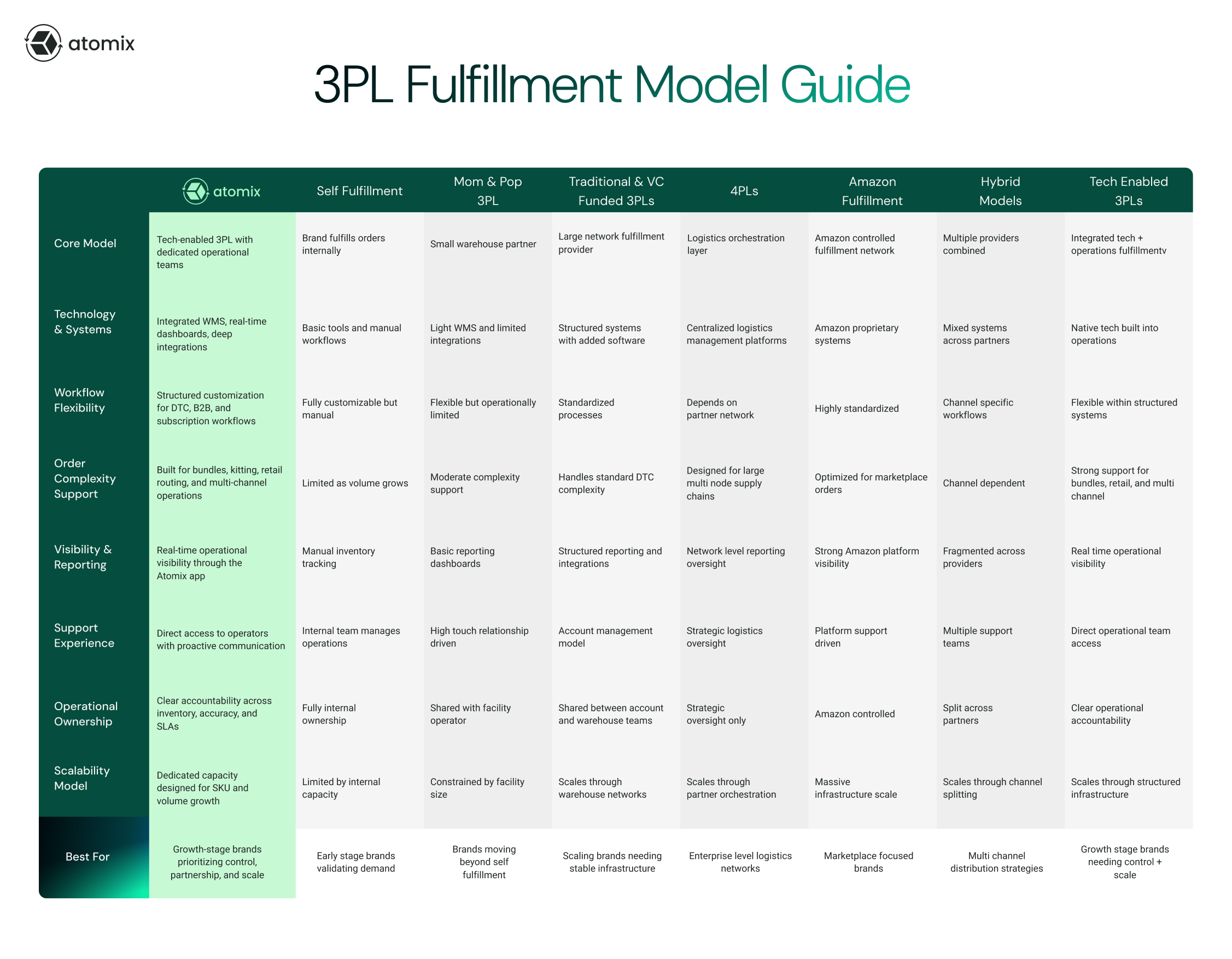
The fulfillment landscape in 2026 breaks into seven categories. Here is how they compare across the dimensions that matter most to scaling brands.
Self Fulfillment: Is Doing It Yourself Worth It?
Self fulfillment means your brand owns and operates every step of the fulfillment process internally, from receiving inventory to packing and shipping orders.
What it looks like in practice:
- Your team manages picking, packing, and shipping
- Inventory tracking is manual or built on basic tools
- Workflow flexibility is high but everything depends on your own labor
- Visibility is limited to what your team tracks internally
Where it works: Early-stage brands with low order volume who are still validating product-market fit. Self fulfillment keeps costs variable and gives founders direct control while demand is unpredictable.
Where it breaks down: Self fulfillment creates a hard ceiling. As volume grows, labor costs rise, error rates increase, and your team's time is consumed by operational work instead of brand building. Most brands outgrow it between 50 and 200 orders per day.
Scalability: Limited by internal capacity. There is no path to scale without either hiring heavily or transitioning to a 3PL.
Mom and Pop 3PLs: A Step Up or a Lateral Move?
Mom and pop 3PLs are small, independent warehouse operations that take on fulfillment for a handful of brands. They are often local, relationship-driven, and more flexible than larger providers on paper.
What they offer:
- High-touch, relationship-driven support
- Light WMS and limited integrations
- Flexible but operationally constrained workflows
- Moderate order complexity support
Where they work: Brands moving beyond self fulfillment who want a trusted local partner and do not yet have the volume or complexity to justify a larger 3PL.
Where they break down: Facility size creates a ceiling. Most mom and pop operations cannot support significant volume growth, SKU expansion, or advanced workflows like kitting and subscription box assembly. When your brand scales, they often cannot scale with you.
Scalability: Constrained by facility size. Growth requires switching partners at a disruptive moment.
Traditional and VC-Funded 3PLs: Scale Without Accountability?
Traditional and VC-funded 3PLs are large-network fulfillment providers built to handle significant volume across multiple facilities. ShipBob falls into this category. So do many of the legacy 3PL brands that have raised institutional capital to expand their warehouse footprint.
What they offer:
- Structured systems with additional software layers
- Handles standard DTC order complexity
- Structured reporting and integrations
- Account management model
Where they work: Scaling brands that need stable infrastructure, predictable capacity, and access to a multi-facility network.
Where they break down: Accountability becomes diffuse at scale. Your account is managed rather than owned. When exceptions happen, resolution requires navigating support tiers rather than talking directly to the operator running your pods. Custom workflows are possible but often standardized out of the default offering.
Scalability: Scales through warehouse networks, but SLA consistency can vary by facility.
4PLs: When Does a Logistics Orchestration Layer Make Sense?
A 4PL, or fourth-party logistics provider, does not operate warehouses directly. Instead, they sit above the fulfillment layer and orchestrate a network of 3PLs, carriers, and logistics partners on your behalf.
What they offer:
- Centralized logistics management platforms
- Network-level reporting oversight
- Strategic logistics oversight as the primary support model
- Designed for large multi-node supply chains
Where they work: Enterprise-level brands with genuinely complex, multi-node supply chains that require logistics strategy and orchestration across many partners simultaneously.
Where they break down: For most growth-stage DTC brands, a 4PL adds a layer of abstraction that obscures accountability. When an order fails, determining which partner in the network owns resolution takes time you do not have. Operational ownership is described as strategic oversight only, meaning no one in the chain has direct hands-on accountability.
Scalability: Scales through partner orchestration, not direct operational control.
Amazon Fulfillment (MCF): Fast Shipping vs Brand Control
Amazon Multi-Channel Fulfillment uses Amazon's infrastructure to fulfill orders from non-Amazon channels. It is fast and leverages Prime-level logistics. But the tradeoffs are significant for brands that care about customer experience.
What it offers:
- Amazon proprietary systems
- Optimized for marketplace orders
- Massive infrastructure scale
- Strong Amazon platform visibility
Where it works: Marketplace-focused brands whose primary sales channel is Amazon and who are comfortable with Amazon-branded or plain packaging.
Where it breaks down: Amazon controls your fulfillment experience entirely. Custom packing rules are not supported. Branded unboxing is not possible. Inventory is locked within Amazon's ecosystem. For brands selling across DTC, B2B, and wholesale channels, MCF cannot support the full picture.
Scalability: Massive infrastructure, but only within Amazon's channel-specific constraints.
Hybrid Models: More Flexibility or More Complexity?
Hybrid models combine multiple fulfillment providers to cover different channels or geographies. A brand might use Amazon MCF for marketplace orders and a 3PL for DTC, for example.
What they offer:
- Channel-specific workflows tailored to each provider
- Coverage across multiple sales channels
- Mixed systems across partners
Where they work: Multi-channel distribution strategies where no single provider can cover all channels efficiently.
Where they break down: Fragmentation. Inventory data lives across providers. Support teams are separate. Reporting is not unified. When something goes wrong, accountability is split across partners, which means slower resolution and more internal overhead to manage. Visibility is fragmented across providers.
Scalability: Scales through channel splitting, but operational complexity grows with each added partner.
Tech-Enabled 3PLs: What Makes Them Different?
Tech-enabled 3PLs combine integrated warehouse management technology with direct operational ownership. Atomix operates in this category. The defining characteristic is that the technology is native to the operation, not layered on top of a legacy warehouse model.
What they offer:
- Integrated WMS with real-time dashboards and deep integrations
- Structured customization for DTC, B2B, and subscription workflows
- Built for bundles, kitting, retail routing, and multi-channel operations
- Real-time operational visibility through the Atomix App
- Direct access to operators with proactive communication
- Clear accountability across inventory, accuracy, and SLAs
- Dedicated capacity designed for SKU and volume growth
Where they work: Growth-stage brands that need a fulfillment partner, not just a fulfillment vendor. Brands with multi-SKU operations, complex packing rules, kitting workflows, or subscription assembly requirements. Brands where customer experience is a competitive advantage.
Where they have limits: Tech-enabled 3PLs are not the cheapest option per unit at very early stages. The value compounds as order complexity and volume grow.
Scalability: Scales through structured infrastructure with dedicated capacity built around your SKU mix and volume trajectory.
How Do the Seven Models Compare Across Key Dimensions?
Which Fulfillment Model Is Right for Your Brand?
Use this as a starting framework based on where your brand is today.
You are likely a self fulfillment candidate if you are pre-product-market fit, shipping fewer than 50 orders per day, and need to keep fixed costs minimal while validating demand.
You are likely a mom and pop 3PL candidate if you have outgrown your own storage space and want a hands-on local relationship, but your order volume and complexity are still relatively simple.
You are likely a traditional 3PL candidate if you need multi-facility coverage, are shipping at significant volume, and have relatively standardized DTC workflows without heavy customization requirements.
You are likely a 4PL candidate if you are an enterprise brand managing a genuinely complex multi-node supply chain that requires logistics strategy and orchestration across many partners.
You are likely an Amazon MCF candidate if your primary business is Amazon marketplace and you need fast shipping without managing a warehouse relationship.
You are likely a hybrid model candidate if you sell across multiple channels with fundamentally different fulfillment requirements that no single provider can serve.
You are likely a tech-enabled 3PL candidate if you are a growth-stage brand that needs a real operational partner. If you run multi-SKU orders, bundles, kitting, subscription box assembly, or branded unboxing workflows, and you need real-time visibility and direct accountability from the team handling your inventory, this is where Atomix was built to operate.
Summary
The fulfillment model you choose is one of the highest-leverage operational decisions your brand makes. It shapes your customer experience, your team's bandwidth, your unit economics, and your ability to scale without breaking.
Self fulfillment and mom and pop 3PLs work at early stages. Traditional 3PLs provide scale. 4PLs serve enterprise complexity. Amazon MCF serves marketplace-first brands. Hybrid models serve multi-channel distribution. Tech-enabled 3PLs like Atomix serve the growth-stage brand that needs a real partner, not just a warehouse.
The questions worth asking before you decide: Who owns my account when something goes wrong? Can this model support my order complexity today and in 12 months? What does my team's visibility into operations look like? And am I choosing a vendor or a partner?
Want to see how Atomix fits your specific fulfillment requirements?

.svg)
.svg)
.svg)