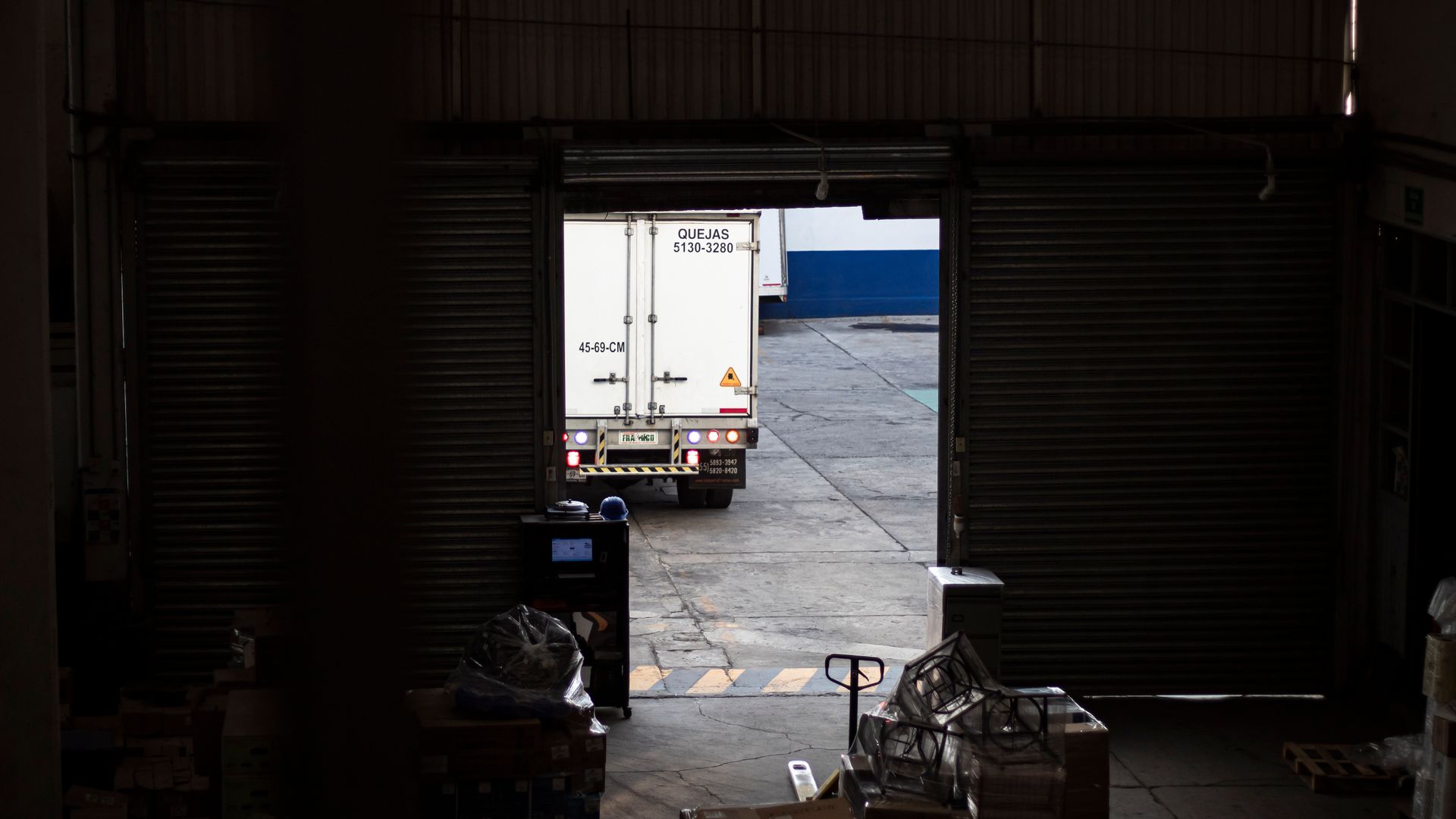
Dock-to-Stock Time: What It Measures and What to Expect From a 3PL

Short answer: Dock-to-stock time is the time between an inbound shipment arriving at a warehouse and that inventory being available to sell. For an ecommerce brand it is the gap between "the truck showed up" and "orders can ship again." A common 3PL commitment is 24 to 48 business hours, and Atomix reports an average of 48 hours or less. The number only means something once you know where the clock starts and stops.
What does dock-to-stock time measure?
It covers every step between the dock door and a pickable, countable location:
- Arrival and check-in of the truck or parcel delivery.
- Unloading and counting cartons, then units, against the advance ship notice (ASN).
- Inspection and labeling where SKUs need barcodes or lot and expiration capture.
- Putaway into a storage or pick location.
- System confirmation, when inventory syncs to your store and becomes sellable.
For what happens inside each step, including ASNs, appointments and discrepancies, see 3PL receiving: what happens between the dock and the pick face.
How do you calculate dock-to-stock time?
Dock-to-stock time = time inventory is available to sell − time the shipment arrived. Calculate it per receipt, then report the average and the slowest receipts.
Before you compare two 3PLs' numbers, pin down four definitions:
| Question | Why it changes the number |
|---|---|
| Does the clock start at delivery, at check-in, or at the dock appointment? | A truck can wait hours in the yard before check-in. |
| Is it business hours or clock hours? | "48 business hours" over a weekend can be four calendar days. |
| Does it stop at putaway or when inventory syncs to your store? | Stock on a shelf isn't sellable until the system says so. |
| Which shipments are excluded? | Non-compliant inbounds, such as no ASN or unlabeled mixed cartons, are often excluded from the commitment. |
Dock-to-stock is a standard warehouse metric: WERC's 2026 DC Measures report lists dock-to-stock cycle time, in hours, among its most popular measures.
What is a good dock-to-stock time for a 3PL?
Our guide to fulfillment SLAs describes a common commitment of receiving and shelving inbound inventory within 24 to 48 business hours of delivery, and our receiving guide notes one to three business days as a common service standard. Expect it to slow during peak unless your contract says otherwise.
Atomix lists an average dock-to-stock time of 48 hours or less on its fulfillment pricing page and homepage, labeled an operational benchmark based on historical client performance. It is a reported average, not one of Atomix's four written guarantees.
What does slow receiving cost? A worked example
Assumptions, stated explicitly: a best-selling SKU sells 40 units a day at $35 each, and the warehouse has run out while a replenishment shipment sits at the dock. One 3PL makes it sellable in 2 days, another in 5.
| Line | Calculation | Result |
|---|---|---|
| Daily sales at risk | 40 units × $35 | $1,400 |
| Extra days out of stock | 5 days − 2 days | 3 days |
| Sales at risk from slower receiving | $1,400 × 3 | $4,200 |
Receiving speed only costs you when stock is low or a launch is waiting, but those are exactly the moments that matter. Some customers wait; others buy elsewhere. Faster dock-to-stock also lets you hold less safety stock, because the gap between "arrived" and "sellable" is shorter.
What slows dock-to-stock time down?
- No ASN, or an ASN that doesn't match the shipment. The warehouse has to count blind and reconcile.
- Mixed-SKU cartons and missing barcodes. Each unit has to be sorted and labeled by hand.
- Unscheduled deliveries that arrive without a dock appointment.
- Lot, expiration or serial capture on products that need it.
- Peak season, when inbound volume rises at the same time as orders.
Most of these are fixable on the brand side. Our guide on how to send inventory to a 3PL covers carton labels, packing lists and ASNs.
How do you hold a 3PL to its dock-to-stock time?
- Ask for the commitment in writing, with the clock start, clock stop and exclusions defined.
- Ask how it is measured and whether you can see receipt timestamps in the portal.
- Check it yourself: compare the carrier's delivery timestamp with when inventory increases in your store.
- Ask what happens during peak and for large container receipts.
- Ask how discrepancies are reported, so a short shipment isn't hidden inside a slow receipt.
Once stock is in, accuracy matters as much as speed. See cycle counting and inventory accuracy, and if you're comparing providers, our questions to ask a 3PL before signing.
Frequently asked questions
What is dock-to-stock time?
It is the time between an inbound shipment arriving at a warehouse and the inventory being available to sell. It includes unloading, counting, inspection, putaway and the system update that makes stock sellable.
How is dock-to-stock time calculated?
Subtract the time the shipment arrived from the time its inventory became available to sell, for each receipt. Then track the average and the slowest receipts, and agree on whether the clock uses business or calendar hours.
What is a good dock-to-stock time?
A common 3PL commitment is 24 to 48 business hours from delivery. Atomix reports an average of 48 hours or less, based on historical client performance.
Why does my 3PL take longer to receive some shipments?
Missing or inaccurate ASNs, mixed-SKU cartons, missing barcodes, unscheduled deliveries and peak-season volume all slow receiving. Many commitments exclude shipments that don't follow the warehouse's receiving guidelines.
Is dock-to-stock the same as receiving time?
Close, but not always. Some warehouses stop the receiving clock when units are counted, while dock-to-stock should run until inventory is put away and sellable. Ask which one a quoted number measures.
Planning a launch or a move to a new warehouse? Book a free strategy session with Atomix.
Sources: WERC 2026 DC Measures report announcement; Atomix fulfillment pricing; Atomix fulfillment SLAs guide.